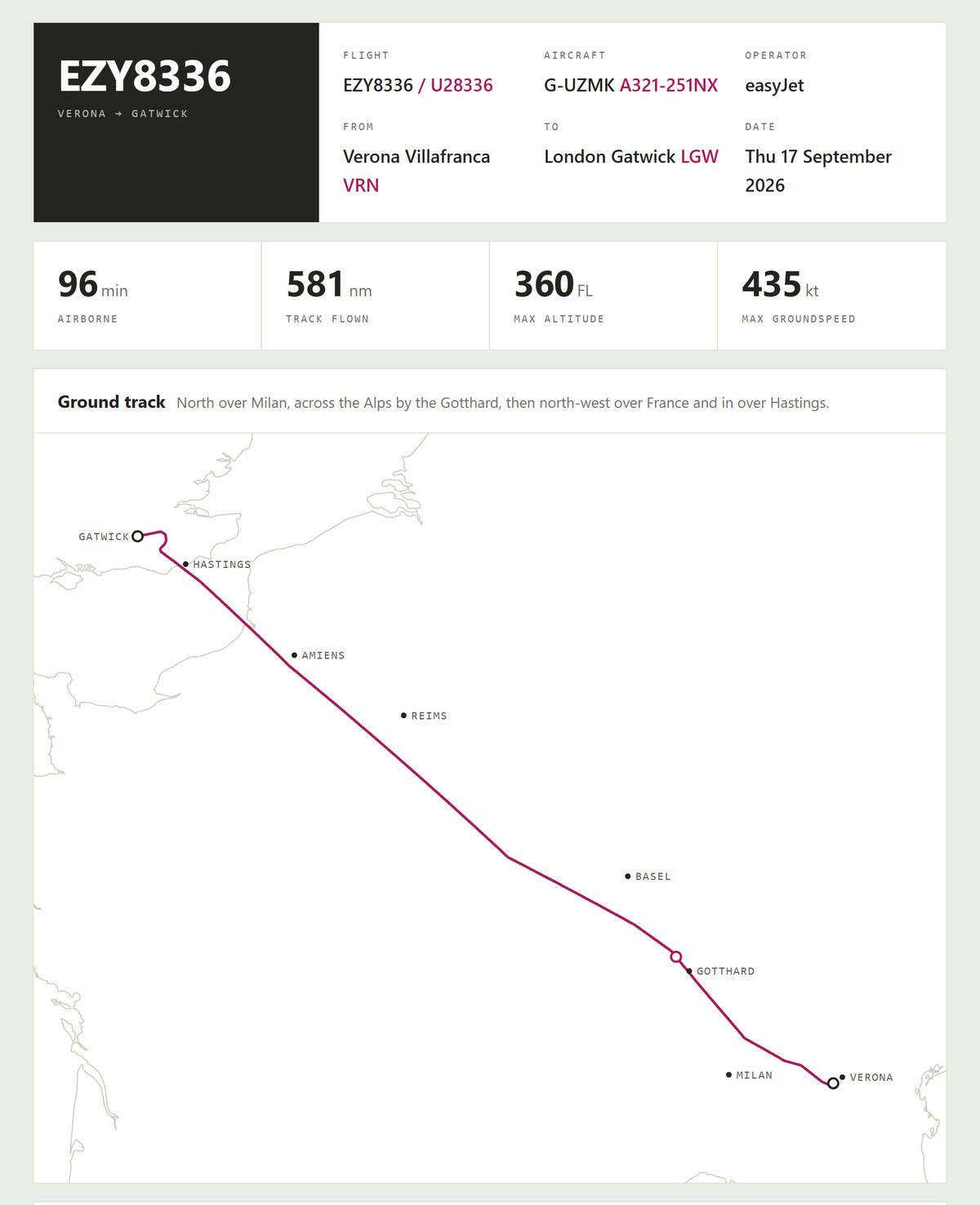
Yesterday morning I flew home from Verona. easyJet EZY8336, an Airbus A321neo, G-UZMK, a little under six hundred nautical miles to Gatwick. Afterwards I pulled the aircraft's own position reports for the flight and laid them out, mostly out of curiosity about the route over the Alps.
The Alps turned out not to be the interesting part. The interesting part was how much of the flight was spent coming down.
Ninety-six minutes, in three pieces
From wheels off at Verona to wheels on at Gatwick was 96 minutes. They divide up like this:
- 16 minutes climbing to the cruise
- 52 minutes at 35,000 feet or above
- 28 minutes descending
So the cruise — the part that feels like the whole flight — was barely half of it. Nearly a third of the time in the air was the descent.
It started over Amiens
The top of descent came at 11:03 UK time, near Amiens in northern France. At that moment the aircraft was 108 nautical miles from Gatwick in a straight line, and it flew 121 to get there: on across Picardy, out over the Channel, in over the coast near Hastings and round onto the runway.
Put another way, the aircraft began landing before it had left France.
Why so early
There is an old rule of thumb for planning a descent, known as the rule of three: allow three nautical miles for every thousand feet you need to lose. It gives a gentle path of about three degrees, which is comfortable in the cabin and is the same angle as a normal final approach.
The aircraft was at 35,000 feet when it started down. Three miles per thousand feet makes that 105 miles. This flight began its descent at 108.
Averaged over the whole way down it lost about 1,250 feet a minute, which is slow enough that most people on board never notice the moment it begins.
The high point was over the Alps
For the record, the Alps did deliver. The highest fix of the whole flight — 36,050 feet — came 22 minutes after take-off, about 12 nautical miles from the Gotthard Pass. The aircraft went up past Milan, crossed the mountains near the Gotthard, and then ran north-west across France in what was very nearly a straight line: 561 nautical miles as the crow flies between the two airports, 581 actually flown. Twenty miles of wiggle across three borders.
What the radar showed
Nothing of this flight — it was never near my desk. But it has changed how I read the screen. When something turns up at three thousand feet, it has either just left or is nearly home, and if it is nearly home then its landing began a hundred miles and twenty-odd minutes ago, somewhere I will never see. The little altitude figure next to each aircraft is the last line of a much longer story.
Sources
- Archived ADS-B trace for G-UZMK (hex 40812D), 17 September 2026 — airplanes.live
- Rule of three (aeronautics) — Wikipedia
Every time and distance above was checked against the raw position reports.