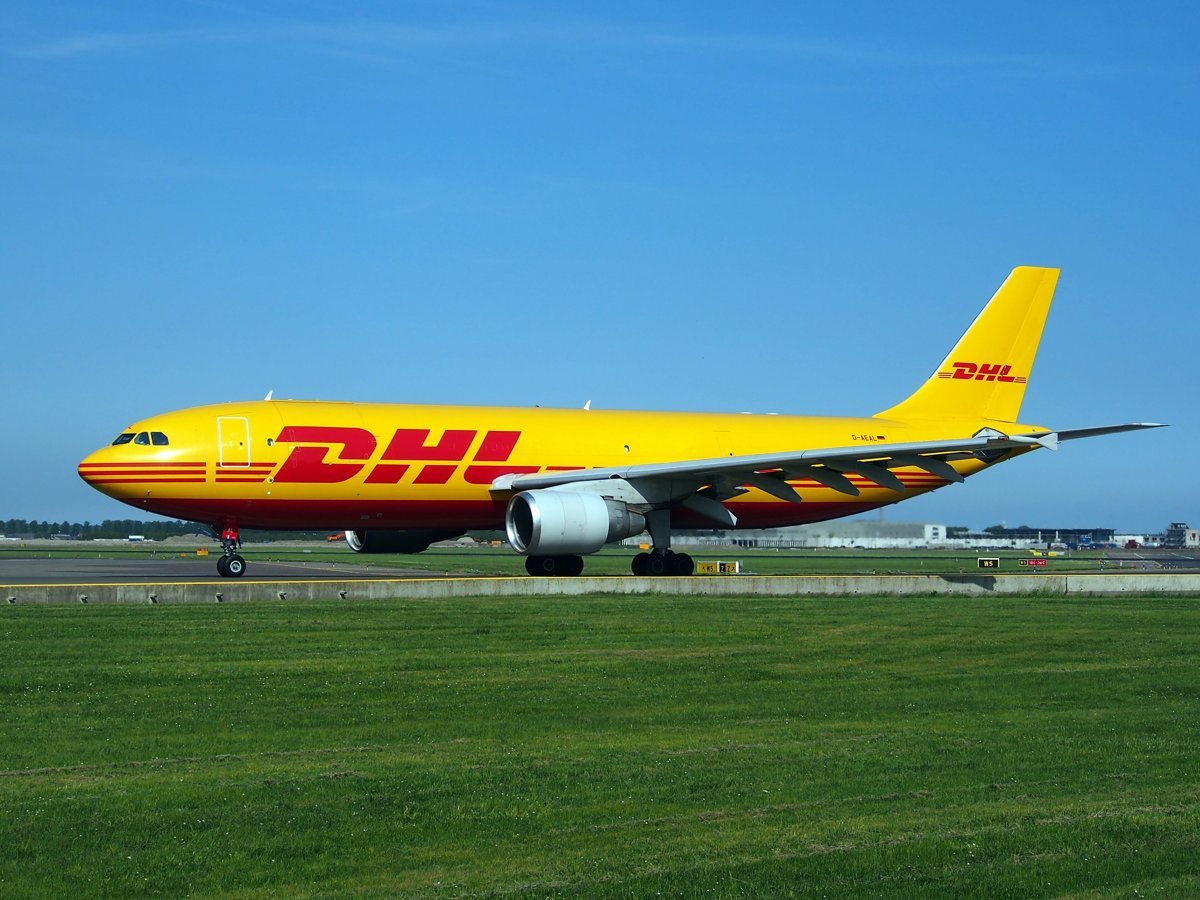
On Sunday 27 September 2026 the little radar on my desk labelled three aircraft "Airbus A300-600". The first was D-AEAL, flying as BCS6769 at 4,525 feet at about 10:04. The second was D-AZMO, BCS870 at 30,950 feet, at about 14:22. The third was S5-ABX, MNB724 at 3,350 feet, at about 17:06, with ISL→LTN on its route line. All three are freighters, and no two of them started life the same way.
Three airframes, three lives
D-AEAL was built in December 1992 as a passenger jet for Japan Air System, and passed to Japan Airlines in 2004. In March 2012 it was delivered to European Air Transport as a converted freighter, and it has flown parcels for DHL since.
D-AZMO is the youngest. It first flew on 19 July 2006 as a factory-built freighter, an A300F4-622R, for the US operator Galaxy Airlines. It joined European Air Transport Leipzig in April 2015 and was repainted in DHL colours that August.
S5-ABX is an A300C4-605R that first flew on 26 March 1999. It has had several owners and registrations, and from June 2008 it flew for MNG Airlines in Turkey as TC-MNV. It now wears a Slovenian registration; PlaneLogger records it joining Solinair, MNG's Slovenian subsidiary, in April 2026.
What the callsigns mean
The letters at the start of a callsign are usually the operator's three-letter ICAO code. BCS belongs to European Air Transport Leipzig, wholly owned by Deutsche Post and the largest operator of DHL's European air network. MNB is MNG Airlines, based in Istanbul. Two DHL-linked flights and one MNG flight, on a type most airlines gave up on years ago.
One caution about that ISL→LTN route line: aircraft do not broadcast their origin and destination, so trackers fill it in from a database keyed on the callsign. I treat it as a hint rather than a fact.
Why it is rare, and why it lasts
Airbus's first airliner flew on 28 October 1972. The A300-600, the version that shares its two-crew glass cockpit with the smaller A310, first flew on 8 July 1983 and entered service in June 1984 with Saudi Arabian Airlines. In all, 561 A300s were built between 1971 and 2007, and the last one, an A300-600F, was delivered to FedEx Express on 12 July 2007.
By April 2025 about 209 were still in commercial service, and the biggest freighter operators were FedEx with 63, UPS with 52 and European Air Transport Leipzig with 25. So the 33-year-old D-AEAL and the 20-year-old D-AZMO are not oddities. They are ordinary members of the surviving fleet.
Age has a cost. When DHL moved nine A300-600 freighters from Air Hong Kong to Europe, it said the difficulty was support: passenger airlines no longer fly the type, so specialist maintenance providers, training simulators and qualified mechanics are hard to find in Asia. In Europe the aircraft now fly with European Air Transport and ASL Airlines Ireland, while the Asian operation got larger A330-300 freighters, which carry roughly 65 tonnes against about 40 for an A300-600.
That is the pattern I keep seeing on my screen. Passenger jets get retired, and freighters made from them, or built as freighters at the very end of production, quietly do the parcel runs. On a busy day, an A300 overhead is a fair bet.
Sources
- Airbus A300 — Wikipedia
- Airbus delivers last A300 — Flight International, July 2007
- European Air Transport Leipzig — Wikipedia
- MNG Airlines — Wikipedia
- Solinair — Wikipedia
- DHL relocates A300 freighters to Europe for better sustainment — FreightWaves
- European Air Transport Leipzig takes delivery of its first A300B4-622R freighter — World Airline News, 8 November 2011
- D-AEAL, msn 679 airframe record — JetPhotos
- D-AZMO, msn 872 airframe record — PlaneLogger
- S5-ABX, msn 758 airframe record — PlaneLogger
- Radar catches: my own footage, 27 September 2026
- Photograph: DHL A300-600F D-AEAL at Amsterdam, 2014, by Alf van Beem (CC0), via Wikimedia Commons