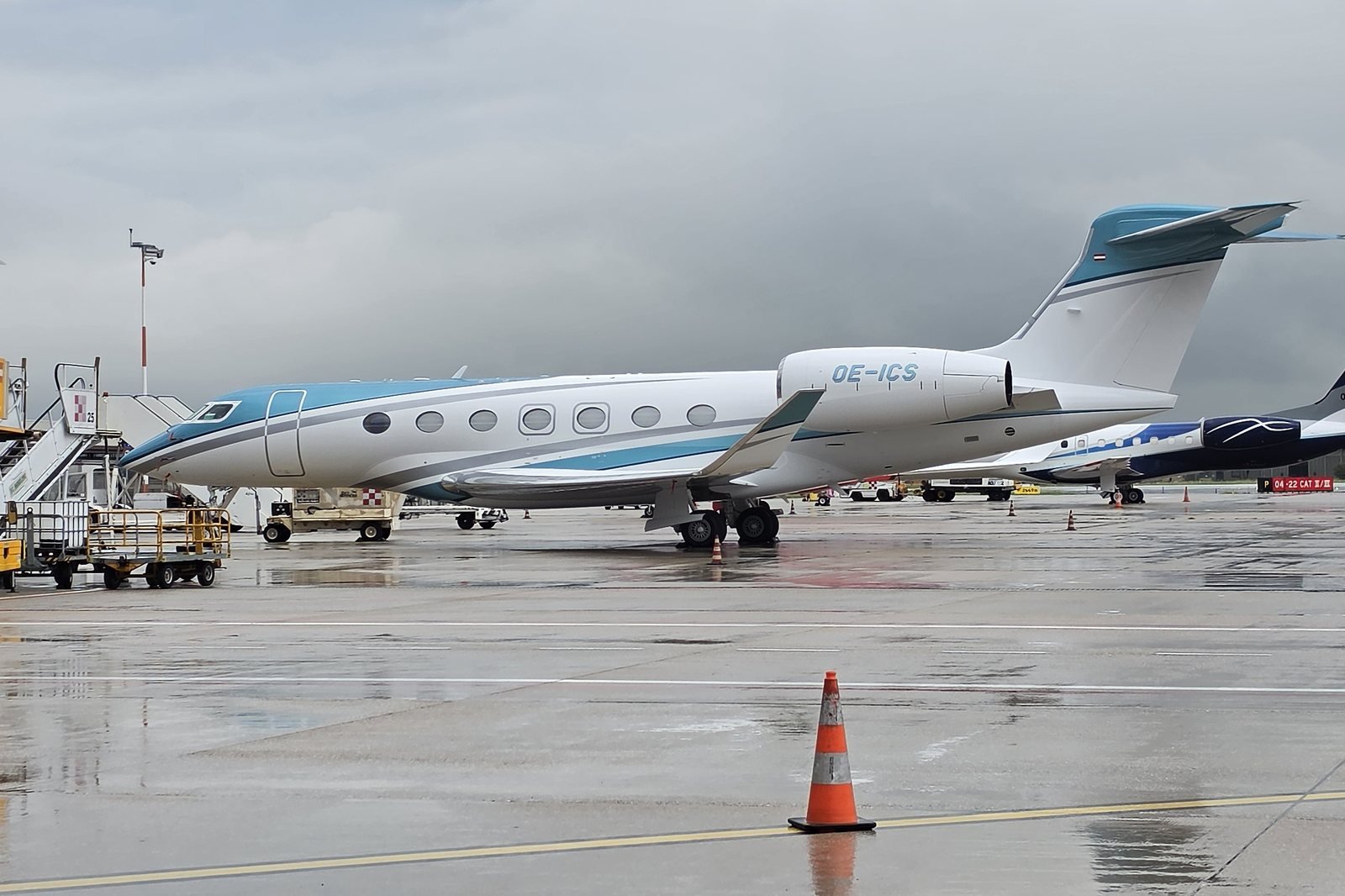
I was standing on the apron at Verona this morning, about ten o'clock, wet concrete and low cloud, when this taxied past and parked. OE-ICS. I knew what it was before I could read the registration, and if you've spent any time around business jets, you'd have known too.
It's the windows.
The tell
Most business jets have windows that are rounded rectangles — the same basic shape as an airliner's, just fewer of them. Gulfstreams have ovals. Proper, unmistakable ovals, like a row of eggs laid on their side. It's been that way since the Gulfstream II in the 1960s, and it's the one thing the company has never redesigned.
On this one — a G600 — there are fourteen of them, seven down each side, and each is 28 inches across. Gulfstream call them Panoramic Oval Windows and they're the largest in business aviation. (The newer G700 has twenty, if you want to be pedantic about it.) Count seven ovals on a side and you've got yourself a G500 or G600 without needing to see a badge.
So that's the spotter's trick. Now the interesting bit.
The part you can't see
Inside the flight deck, the G500 and G600 were the first civil aircraft to fly with what are called active sidesticks.
A sidestick is the small control stick beside the pilot's seat, in place of a traditional yoke — Airbus have used them since the A320. But Airbus sidesticks are passive: each pilot's stick moves independently, and if one pilot pushes forward while the other pulls back, the aircraft simply averages the two and neither can feel what the other is doing. That has caused real problems over the years.
Gulfstream's sidesticks, made by BAE Systems, are linked. Move one and the other moves with it. If the captain makes an input, the first officer feels it in their hand, and vice versa. It's the way a mechanical control column has always worked, brought back into a fly-by-wire aeroplane — and until the G500 arrived in 2018, that kind of two-way link had only ever existed in military aircraft.
None of that is visible from the apron. But it's why a G600 is worth a second look beyond the windows.
OE-
The registration prefix tells you where an aircraft is registered, and OE- is Austria. This one flies with Avcon Jet, a Vienna-based operator.
Prefixes are a rabbit hole worth falling into. G- is the UK, EC- is Spain, D- is Germany. And 9H- — which is on every VistaJet in the world, including the one I photographed on this same apron on Monday — is Malta. You'll see a lot of 9H- and OE- on business jets around Europe and it doesn't mean they're all Maltese or Austrian in any meaningful sense. But that's a post for another day.
What the radar showed
No Gulfstream on my own screen yet. Plenty of the same class, though — an Embraer EMB-550 at 6,100 feet, a Bombardier BD-700 at 6,000, a VistaJet Global at 4,000, all caught inside a single afternoon at the desk.
That's the thing about business jets: they don't follow the airliner flows. The scheduled traffic overhead runs in neat lines at neat altitudes, and the bizjets cut across it — climbing or descending through levels the big stuff left behind half an hour ago, going somewhere that isn't on any departure board. Once you know to look for them, they turn up far more often than you'd expect.
Sources
- Gulfstream G600 — Gulfstream Aerospace (gulfstream.com)
- Gulfstream Implements First Commercial Active Sticks — BAE Systems
- Active Sidesticks Pave Gulfstream Flight Control Path — Aviation International News, 2016
- OE-ICS — Flightradar24 aircraft data
All photographs my own, Verona, 17 September 2026.