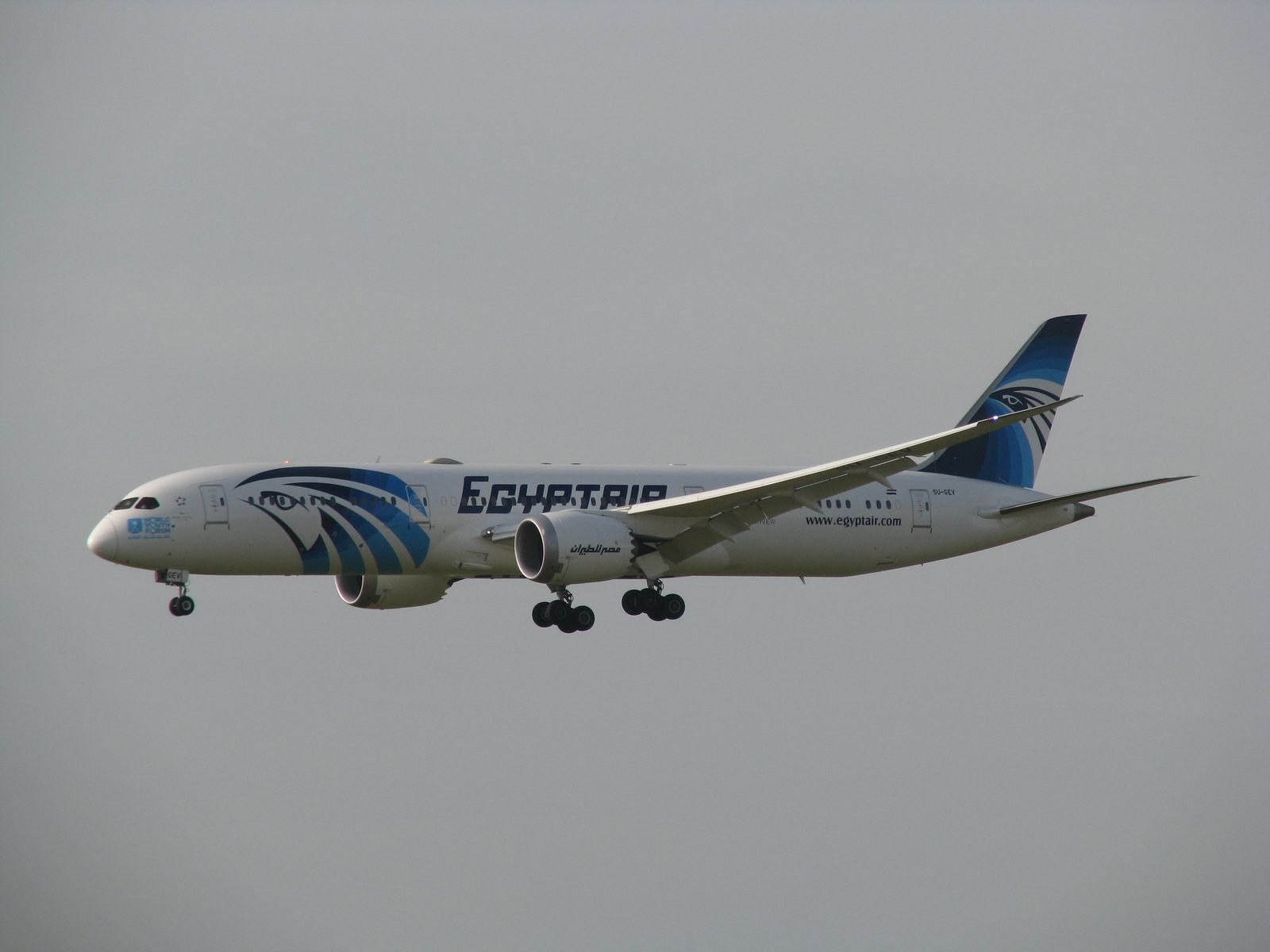
On the morning of 27 September 2026 the radar on my desk showed an EgyptAir Boeing 787-9, SU-GEV, flying as MSR995 at 35,975 feet. A few minutes later it showed an Air Canada A330-300, C-GXZD, flying as ACA818, level at 39,000 feet. MS995 is scheduled from Cairo to Toronto. AC818 is scheduled from Montreal to Venice. Neither lands in Britain.
They were not getting the airspace for free. Almost every flight that uses UK airspace, landing or not, pays an en-route charge for it.
The formula
The rules are set out in the Civil Aviation Authority's charges specification. The charge for each flight is a number of "service units" multiplied by a unit rate.
The service units come from two factors multiplied together:
- Distance. The great-circle distance between where the flight enters UK airspace (or takes off) and where it leaves (or lands), in kilometres, divided by 100. Flights that take off or land in the UK knock 20km off for each.
- Weight. The square root of the aircraft's maximum take-off weight in tonnes, divided by 50.
So one service unit is 100km flown by a 50-tonne aircraft. The square root means a jet five times heavier does not pay five times as much. It pays a bit over twice as much.
What that comes to
Eurocontrol publishes the rates every month. For September 2026 the UK rate is €89.63 per service unit, at an exchange rate of £0.855895 to the euro. That is £76.71. The CAA's 2026 specification gives the same sterling figure. The UK's rate is effectively fixed in pounds, with the euro figure moving each month to hold it.
Here is a rough worked example, and it is my own arithmetic, not a published figure. Take a 787-9 at 254 tonnes crossing 800km of UK airspace without landing:
- distance factor: 800 ÷ 100 = 8.00
- weight factor: √(254 ÷ 50) = 2.25
- service units: 18.00
- charge: 18.00 × £76.71 ≈ £1,381
Call it around £1,400. A crossing of southern England is often shorter than 800km, so the real bill for a given flight could be less.
Flights heading out over the Atlantic pay again for the oceanic part. The UK AIP lists a flat £60.07 per flight for the Shanwick oceanic area, plus a £39.70 charge for ADS-B data: £99.77 per crossing, whatever the aircraft's size.
Who collects it
The UK en-route charge is billed and collected by Eurocontrol's Central Route Charges Office in Brussels, which passes the money back to the UK. The UK is a Eurocontrol member in its own right, which has nothing to do with the EU. Eurocontrol's own figures show the UK charging zone billed about €1.09 billion in 2025, third behind France and Germany.
The charges pay for en-route air traffic services. The main provider is NATS En Route plc, which provides air traffic control across UK airspace and the eastern North Atlantic and is regulated by the CAA.
Some flights do not pay. The exemptions include military aircraft, search and rescue, any aircraft under 2 tonnes, and VFR-only flights by aircraft of 5,700kg or less.
What it looks like on the screen
The radar cannot tell you where an aircraft is going. But an airliner holding 36,000 or 39,000 feet while everything else around it is climbing out or coming down is a good clue that it is only passing over, and paying for the privilege.
Did you know the ones passing over were paying for it?
Sources
- Eurocontrol Charges Specification 2026 (Official Record Series 7) — Civil Aviation Authority
- Monthly adjusted unit rates, September 2026 — Eurocontrol
- UK AIP GEN 4.2, Air navigation service charges (AIRAC 3 September 2026) — NATS
- CRCO report 2025 — Eurocontrol
- Overview of economic regulation of NATS En Route plc — Civil Aviation Authority
- MSR995 flight schedule — FlightAware
- ACA818 flight schedule — FlightAware
- Radar catches: my own footage, 27 September 2026
- Photograph: EgyptAir 787-9 SU-GEV, 2021, by jounigripen (CC BY 2.0), via Wikimedia Commons