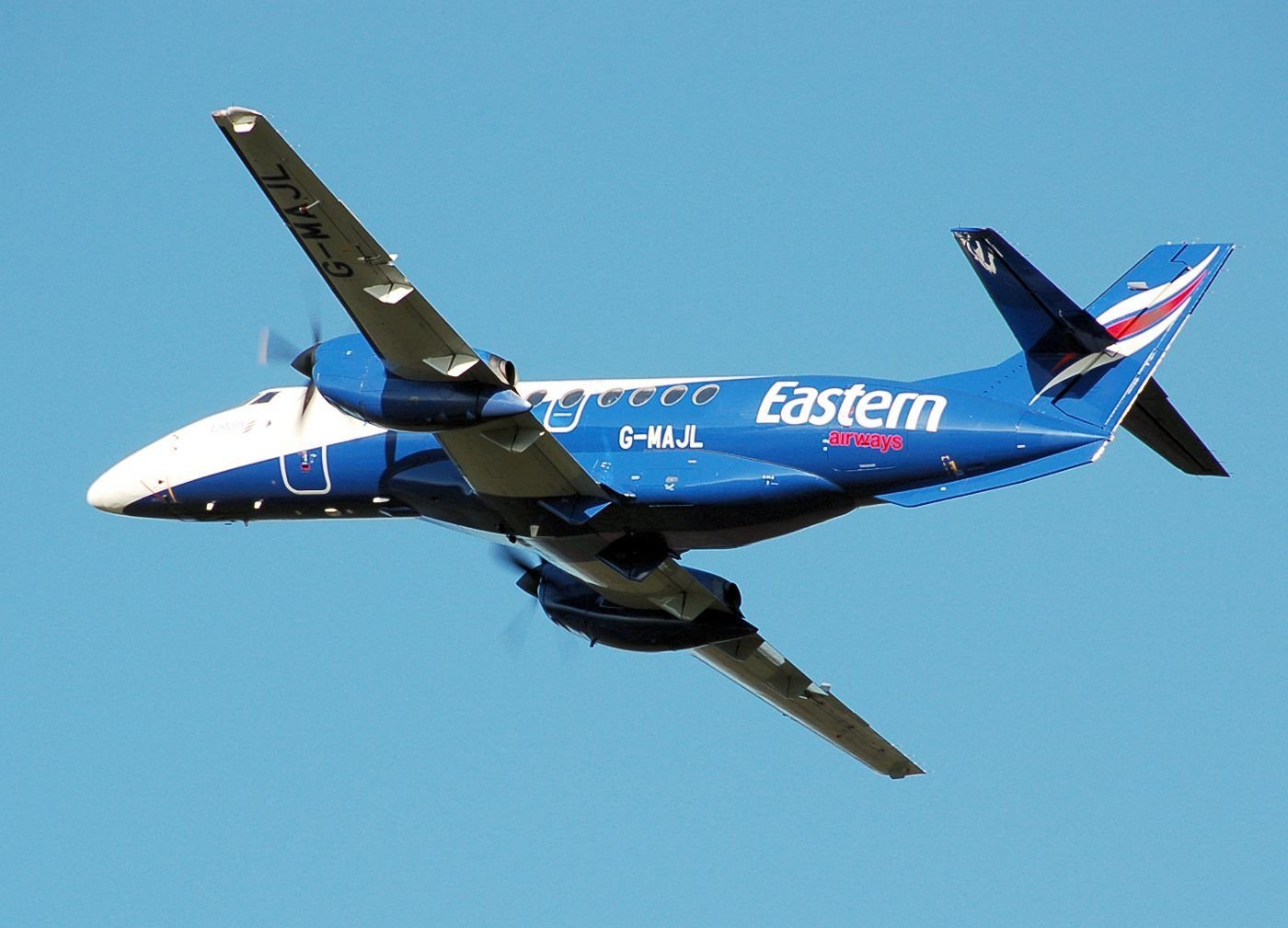
On 25 September 1991 a new twin-turboprop took off from Glasgow Prestwick for the first time. It was the Jetstream 41, a 29-seat regional airliner from British Aerospace, and it had been rolled out at the same airfield six months earlier, on 27 March.
It was a small aeroplane built for a particular job: short, thin routes where a jet would be too big and a larger turboprop would fly half empty. Thirty-five years on, it is a good example of how quickly the regional end of the sky changes.
A stretched Jetstream 31
The Jetstream 41 was a development of the Jetstream 31, which had first flown in 1980 and sold 386 examples. British Aerospace lengthened the fuselage by 16 feet, with a plug of 8 feet 3 inches ahead of the wing and 7 feet 9 inches behind it. That took the cabin to 29 seats in a two-by-one layout.
Power came from two AlliedSignal TPE331-14 turboprops of around 1,650 shaft horsepower each. The type gained UK certification on 23 November 1992, and two days later Manx Airlines took delivery of the first aircraft intended for passenger service.
One hundred and done
The Jetstream 41 did not sell in the numbers of its predecessor. In May 1997 British Aerospace announced that production would end. One hundred production aircraft were delivered, or 104 counting the four prototypes, and the last airframe left Prestwick for completion at Bournemouth in February 1998.
In Britain, the type flew with Manx Airlines and in British Airways Express colours during the 1990s, and later became closely associated with Eastern Airways, which flew it on domestic routes for many years.
The end of UK passenger service
When Eastern Airways filed notice of its intention to appoint administrators on 27 October 2025, all its flights stopped. Its fleet at that point included seven Jetstream 41s, alongside four ATR 72-600s and five Embraer jets. The airline's collapse marked the end of the Jetstream 41's active passenger service in the UK.
The type has not disappeared. At the start of 2025 around twenty were still in commercial service worldwide, with Guna Airlines in Nepal and Proflight Zambia among the main users. But you are now far more likely to see one in a photograph than overhead in Britain.
What it looks like on the screen now
The radar on my desk shows what is flying within its range, labelled with type, registration and callsign. On a session at Prestwick in early September, the airport where the Jetstream 41 first flew, the turboprop airliners that crossed the screen were all ATR 72-600s: two from Aer Lingus Regional and one from Loganair at 19,000 feet.
That is the honest answer to where the Jetstream 41's world went. Regional flying carries on; it is mostly done by bigger turboprops now. The 29-seater from Prestwick belongs to the photographs.
Did you ever fly on one? I would like to hear where.
Sources
- Maiden flight: Jetstream 41 — Airways Magazine
- British Aerospace Jetstream 41 — Wikipedia
- Eastern Airways — Wikipedia
- Photograph: Eastern Airways Jetstream 41 G-MAJL departing Bristol, 2006, by Adrian Pingstone (public domain), via Wikimedia Commons