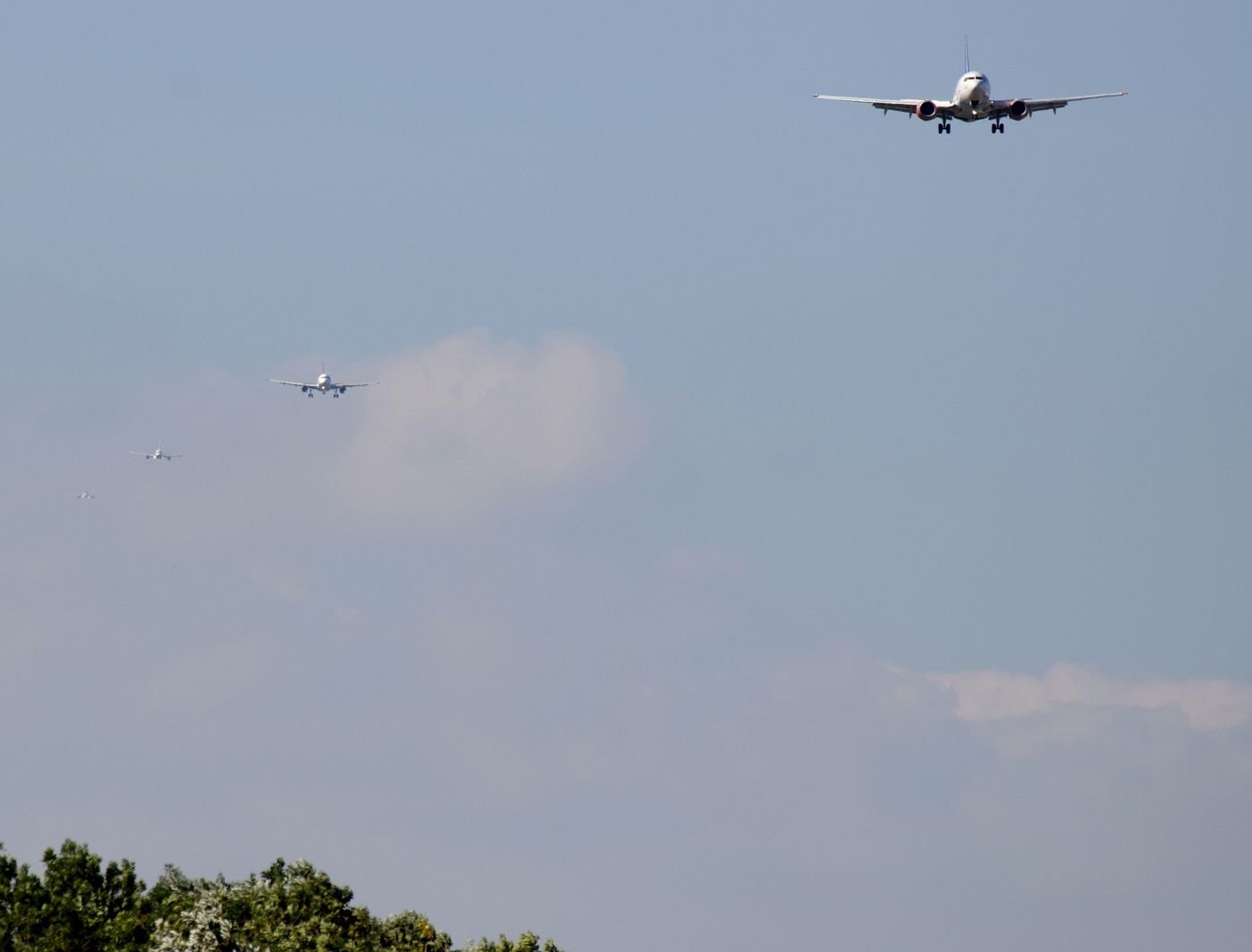
If you live anywhere around London you will have seen it: an airliner that seems to be going round in circles, or passing overhead again a few minutes after it first went by. It is not lost. It is almost certainly waiting its turn to land at Heathrow.
Why Heathrow needs a queue
Heathrow says it handles around 650 arrivals a day on two runways. NATS, the air traffic control provider, has described the airport as scheduled to around 98% of its capacity. At that level there is no slack. To make sure the runway is never left empty for want of an aircraft, controllers need a small supply of arrivals already waiting nearby.
That waiting happens in holding stacks. Heathrow has four, named Bovingdon, Lambourne, Ockham and Biggin, and the airport says their locations have been the same since the 1960s. Roughly, Bovingdon is to the north of Heathrow, Lambourne to the north-east, Ockham to the south and Biggin to the south-east.
How a stack works
Each stack is an oval racetrack pattern flown around a fixed point. Heathrow says the levels are separated by 1,000 feet and the bottom of the stack is around 7,000 feet. NATS describes aircraft in a hold as typically joining at the top, usually around 15,000 feet, and leaving from the base at around 7,000 feet.
As the aircraft at the bottom is called in towards the final approach, the others each step down 1,000 feet. It is a queue built in three dimensions: vertical separation keeps everyone apart, and the racetrack keeps them in one area of sky.
Holding tends to build when arrivals bunch up, and in weather that slows the landing rate, such as strong winds or low cloud. NATS points out that holds let controllers organise arriving aircraft into a safe and efficient landing sequence.
Less time going round
In March 2015 Heathrow became the first airport in the world to use Time-Based Separation. Instead of spacing arriving aircraft by fixed distances, controllers space them by time. In a strong headwind, aircraft cover less ground in the same time, so distance-based spacing slowed the arrival rate on exactly the days it was most needed.
NATS says that in its first year Time-Based Separation let Heathrow land an average of 2.9 more aircraft an hour on strong wind days, and that over its first ten years it cut airborne holding by a total of 1.5 million minutes, almost three years.
The stacks are also changing in another way. NATS says the ground-based radio beacons that hold patterns are built around are being phased out in favour of satellite waypoints.
What it looks like on the screen
The radar on my desk labels each aircraft with its type, registration, callsign and altitude. On the evening of 26 September 2026 it showed an Aer Lingus A320neo, EI-NSA, flying as EIN17J at exactly 8,000 feet. Nearly a minute later it was still there, still at 8,000 feet.
The screen cannot tell you why an aircraft is doing what it is doing. But a jet holding one level while others climb and descend around it is a good reason to look up.
Have you ever watched one circling?
Sources
- Arrival flight paths — Heathrow
- What's the hold up? — NATS, 14 August 2026
- The history of Time-Based Separation — NATS, March 2025
- Radar catch: my own footage, 26 September 2026
- Photograph: four aircraft on approach to Heathrow runway 09L, 2015, by Adrian Pingstone (public domain), via Wikimedia Commons