At about 17:46 on Sunday 27 September 2026, the little radar on my desk picked up an aircraft at 5,375 feet. The label read Gulfstream 4, registration 9H-AMO, callsign GSM450. It stayed on the screen for a little over seven seconds before the display moved on to another aircraft. There was no route on the label, which is normal for a business jet: many have none filed or published.
I should be plain about what that was. It was a Gulfstream IV, not a Gulfstream II, and I have not caught a II or a III. The IV is the nearest relative my screen has caught, two models on from the aircraft that first flew on 2 October 1966, sixty years before I wrote this.
2 October 1966
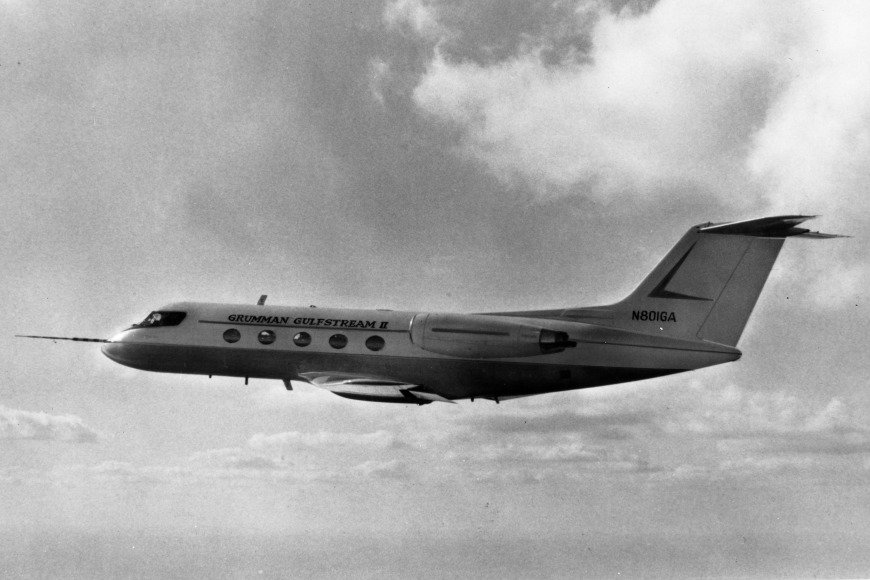
Grumman flew the first Gulfstream II from its plant at Bethpage, New York, on 2 October 1966. The flight lasted 52 minutes. The aircraft was the jet successor to Grumman's turboprop Gulfstream I, with swept wings, a T-tail and two engines mounted on the rear fuselage. The FAA issued its type certificate on 19 October 1967.
A British engine
Those engines were Rolls-Royce Spey Mk 511-8 turbofans. The Spey was a British design, created in the late 1950s with smaller airliners in mind, and it went on to power the BAC One-Eleven and the Hawker Siddeley Trident. Rolls-Royce named it after the River Spey in Scotland, in keeping with its habit of giving jet engines river names.
An American business jet flying on a British airliner engine is the part of the story that stuck with me.
What it started
The Speys did not leave when the Gulfstream II's production ended. The European Union Aviation Safety Agency's type certificate data sheet for the whole family lists the engines like this:
- Gulfstream II, FAA certified 19 October 1967: two Rolls-Royce Spey 511-8.
- Gulfstream III, FAA certified 22 September 1980: the same Spey 511-8s, on a wing six feet wider with winglets.
- Gulfstream IV, FAA certified 22 April 1987: two Rolls-Royce Tay 611-8 turbofans.
- G350 and G450, certified as the GIV-X, a later development of the IV: Tay 611-8C.
So whichever version 9H-AMO is (the label only said Gulfstream 4), it runs on Rolls-Royce Tays, and every jet Gulfstream from the II to the IV was powered by Rolls-Royce.
From business jet to shuttle trainer
NASA later modified Gulfstream IIs so that astronauts could practise the final approach of a space shuttle landing. NASA's own caption on a 2010 photograph at the Kennedy Space Center describes them as modified Gulfstream II business jets that mimic the shuttle's handling in that last phase of landing. The aircraft in the middle of my Reel, N947NA, is one of them, photographed on 3 April 1996.
About the pictures
The photograph of a Gulfstream II prototype, N801GA, comes from the San Diego Air & Space Museum archive and has no date, so I won't claim it shows the first flight. The NASA Gulfstream II, the NASA Gulfstream III and the Gulfstream IV-SP in my pictures are other aircraft of those types, not the one on my screen.
Have you ever spotted a Gulfstream II or III overhead? I'd like to know where.
Sources
- EASA Type-Certificate Data Sheet IM.A.070, Gulfstream G-1159 (G-II), G-1159B (G-IIB), G-1159A (G-III), G-IV, GIV-X, GV: FAA certification dates 19 October 1967, 22 September 1980, 22 April 1987; engines Spey 511-8, Tay 611-8, Tay 611-8C; G-III wing, Issue 13, 6 August 2026
- Gulfstream Marks GII's 40th Anniversary: first flight 2 October 1966, Bethpage, New York, 52 minutes — AVweb, 10 October 2006
- Quick Look: Gulfstream II: first flight at Bethpage, two aft-mounted Rolls-Royce Spey Mk 511-8 turbofans — AOPA, August 2013
- Grumman Gulfstream II: 52-minute first flight at Bethpage, citing Fred J. Knight, Gulfstream: A Tribute to the Ultimate Biz-Jet (1992) — Wikipedia
- Rolls-Royce Spey: designed for smaller airliners, BAC One-Eleven and Trident, named after the River Spey — Wikipedia
- Rolls-Royce engines: what's in a name: river names, the Spey powering the BAC One-Eleven and Trident — UK Aviation News, 30 September 2020
- NASA image KSC-2010-5092: Shuttle Training Aircraft, "modified Gulfstream II business jets", 12 October 2010 — NASA
- NASA image S96-06240: Gulfstream II Shuttle Training Aircraft N947NA, 3 April 1996 — NASA
- Radar catch: my own footage, 27 September 2026
- Photographs: Gulfstream II prototype N801GA, San Diego Air & Space Museum Archives (public domain); Gulfstream II Shuttle Training Aircraft, NASA (public domain); Gulfstream III N804NA, NASA/Jim Ross (public domain); Gulfstream IV-SP N990EA at Frankfurt, 23 September 2013, by Kambui (CC BY 2.0), via Wikimedia Commons