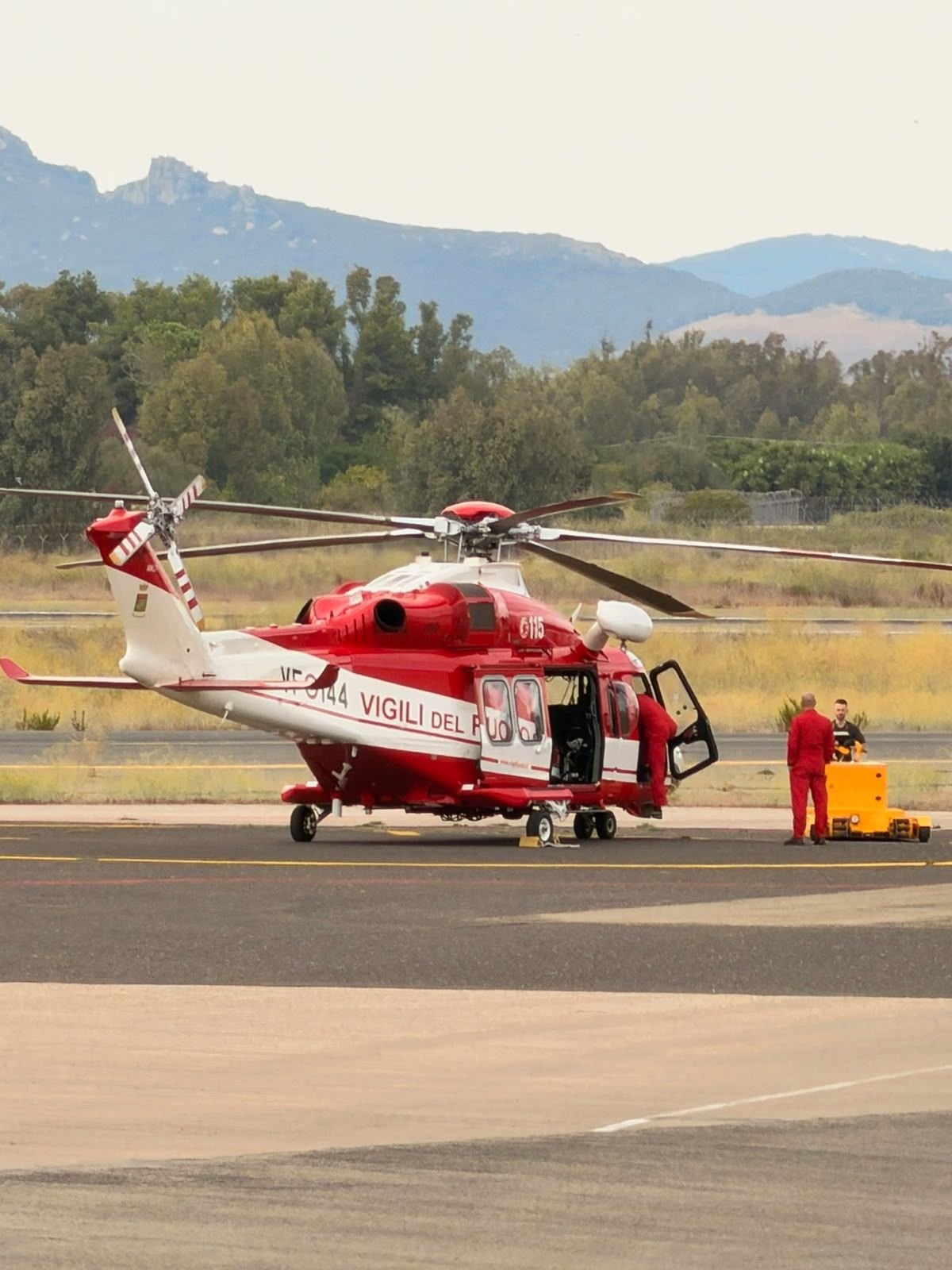
A friend of mine was in Sardinia on 30 September 2026 and sent me this photograph. I didn't take it, and it didn't come off my radar; it is simply too good an aircraft not to write about. It shows a red and white helicopter with "VIGILI DEL FUOCO" along the tail boom, "115" on the nose, and two crew in red suits at the open door.
What it is
The Vigili del Fuoco is Italy's national fire and rescue corps, the Corpo Nazionale dei Vigili del Fuoco, part of the Ministry of the Interior. The helicopter is a Leonardo AW139, a twin-engined medium helicopter that first flew on 3 February 2001. The tail boom reads VF-144, though the first letters are partly hidden behind the tail's horizontal stabiliser. The "144" is clear.
What 115 means
The 115 on the nose is the fire brigade's emergency number. According to the corps' own website it has been the single nationwide number since 1987, under a law passed in 1985. Calls are free from landlines and mobile phones, and are answered by the control room of the provincial command where the caller is.
Why it's called Drago
Fire corps helicopters use the radio name "Drago", Italian for dragon, followed by a number. Sardinian press coverage calls this one Drago 144. I couldn't find an official explanation of why the name was chosen, so I won't guess at one.
Drago 144 in Sardinia
Local reports from August 2020 say a new AW139, VF 144, was assigned to the regional helicopter unit of Sardinia. It was christened with a water ceremony that month and replaced an AB412. The reports described a night-flying system (NGV, "Night Global Vision"), roughly double the flight range of the old helicopter and a higher cruise speed. The crew began training straight away, and it was expected to be fully operational for rescue work by the end of 2020.
I can't say from a photograph that this is that exact airframe. The tail number and the place fit, and that is as far as I'll go.
What the AW139 is for
Italy ordered its first three for the fire corps in December 2018, with an option on twelve more, and a further five followed in June 2019. The aircraft are equipped for maritime and mountain search and rescue, medical rescue, firefighting and disaster relief. Leonardo's own description of the specification includes an external rescue hoist, a cargo hook with provision for a "bambi bucket" (the water bucket used for firefighting), night vision goggle capability, a forward-looking infrared camera, a searchlight, emergency flotation and a medical rack. It is meant to replace the corps' long-serving AB412s.
None of that is visible in a parked photograph, but the open door, the crew and the hoist-ready layout tell you what it is for. A helicopter like this spends its life on the ground waiting, and then leaving quickly.
And the radar?
I do see helicopters on my radar. The clips in this post show AW109s, which are also made by Leonardo, but they are a different, smaller helicopter and not the one in the photograph. What would I like to spot? A fire-service AW139 in red and white, going past.
Sources
- Emergenza 115: nationwide number since 1987, Law 197 of 13 May 1985, free, answered by the provincial command — Corpo Nazionale dei Vigili del Fuoco
- Corpo nazionale dei vigili del fuoco: Ministry of the Interior, red livery with white lettering — Wikipedia (Italian)
- Vigili del Fuoco, Sardegna, "battezzato" in volo il nuovo Drago 144 — Vistanet, 22 August 2020
- Arriva Drago 144, nuovo elicottero per i soccorsi in Sardegna — L'Unione Sarda, 22 August 2020
- Sardegna, arriva il nuovo elicottero Drago 144: il battesimo dell'acqua dei vigili del fuoco — Casteddu Online, 22 August 2020
- Italian National Fire Corps to enhance its emergency multirole airborne capabilities with a contract for three AW139 helicopters — Leonardo, 14 December 2018
- AW139 helicopters will enhance Italian National Fire Corps capabilities — AOFS, 18 December 2018
- Italian National Fire Corps expands AW139 fleet with US$83M order — Vertical, 18 June 2019
- AgustaWestland AW139: first flight 3 February 2001 — Wikipedia
- Photograph: a friend of the author, Sardinia, 30 September 2026
- Radar clips: my own footage, 27 September 2026