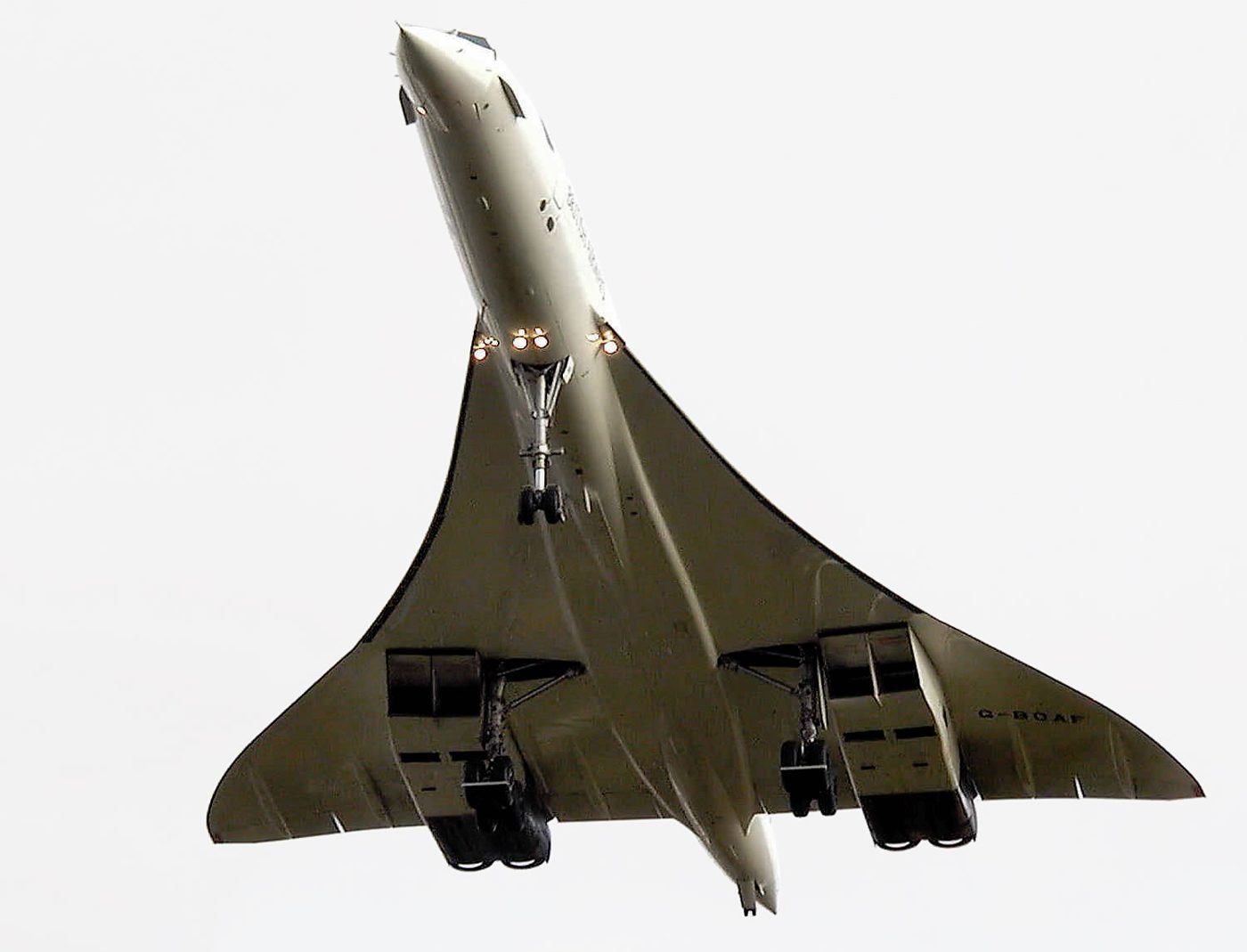
On 26 September 1973, Concorde 02 took off from Washington Dulles and flew to Paris Orly without stopping. It was the first time a Concorde had crossed the North Atlantic non-stop. On board were 32 invited guests, and the flight took 3 hours 47 minutes from gate to gate. TIME reported that a Boeing 747 took about twice as long.
Which Concorde
Concorde 02, registered F-WTSA, was the second of the French pre-production aircraft and the fourth Concorde built. Pre-production aircraft sat between the two prototypes and the airliners that followed: close to the final design, but still test aircraft rather than airline fleet.
The crossing was flown by Jean Franchi. Among the guests were Robert Galley, then the French armed forces minister, and Pierre-Donatien Cot, the director-general of Air France.
Why it was in America
F-WTSA was not in Washington for its own sake. It had been invited to headline the opening of the new Dallas-Fort Worth airport in Texas. The tour went from Orly by way of Las Palmas to Caracas, arriving there on 18 September. On 20 September it flew Caracas to Dallas, the first time a Concorde had landed in the United States.
In Texas it made two Mach 2 flights over the Gulf of Mexico and a display at Dallas. It then flew to Washington Dulles at subsonic speed on 23 September; landing at Dulles needed special federal permission. Three days later it set off home, this time without stopping.
How high, how fast
Concorde cruised at twice the speed of sound, around 1,350 mph, at between 55,000 and 60,000 feet, according to the Smithsonian's National Air and Space Museum. A contemporary account of the 1973 flight by Henri Perrier records that 2 hours 42 minutes of it were supersonic and that it finished its cruise at 58,000 feet.
Where F-WTSA is now
F-WTSA made its last flight on 20 May 1976 and passed to Paris Airports that year. It has been on display at the Musée Delta at Athis-Mons, beside Orly, since April 1988, the airport it flew into in 1973. It wears British Airways colours on one side and Air France on the other.
What the screen shows now
The radar on my desk labels each aircraft with its altitude. On a session at Prestwick in early September, the transatlantic traffic crossing the screen was cruising at between about 32,000 and 39,000 feet. One of them, an Alaska Airlines 787-9, was at 39,000 feet.
Concorde cruised up to 20,000 feet higher than that. The highest label on the screen that afternoon would have been far below it.
Did you ever see Concorde fly?
Sources
- The Concorde's first non-stop transatlantic flight — TIME
- F-WTSA (102) — Heritage Concorde
- Premier vol transatlantique du 26 septembre 1973, Henri Perrier — Concorde Référence (PDF)
- Concorde, Fox Alpha, Air France — Smithsonian National Air and Space Museum
- Radar catches: my own footage, 4 September 2026
- Photograph: British Airways Concorde G-BOAF on the final Concorde landing, Filton, 2003, by Adrian Pingstone (public domain), via Wikimedia Commons