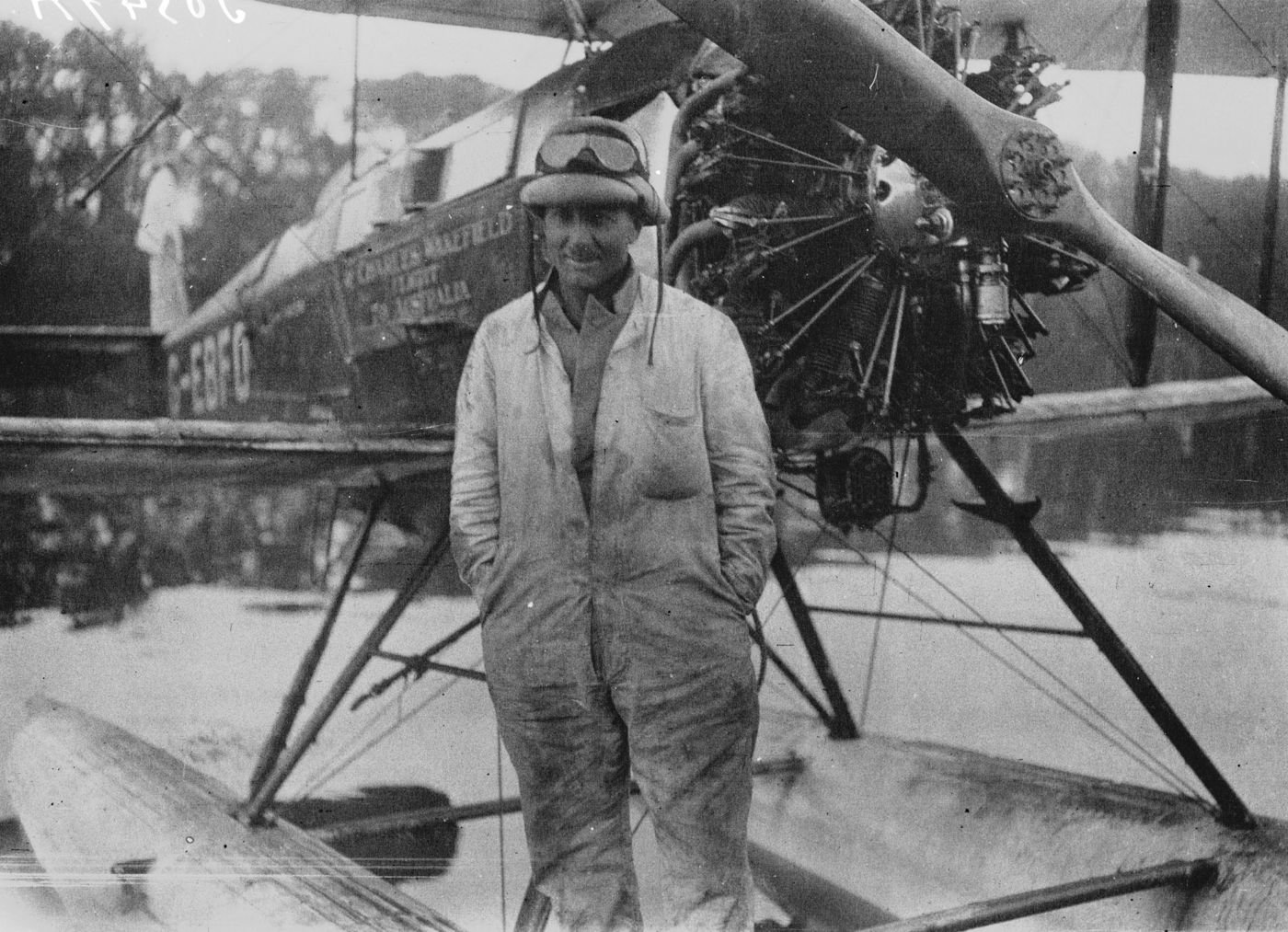
On 1 October 1926 a de Havilland DH.50 floatplane came down on the River Thames beside the Houses of Parliament. The pilot was Alan Cobham, and he was finishing a flight from England to Australia and back. According to the RAF Museum, more than a million people lined the embankments and bridges to see him arrive.
On Thursday 1 October 2026 it will be exactly 100 years.
The aircraft
Cobham flew a de Havilland DH.50J registered G-EBFO, a single-engined biplane with an enclosed cabin and an open cockpit for the pilot. It left England on floats, fitted by Short Brothers at Rochester, and was converted to wheels for the Australian leg before going back onto floats for the journey home.
The route
The RAF Museum's account gives the outline. Cobham began at Rochester in Kent on 30 June 1926, taking off from the River Medway. After 47 days and more than 13,000 miles he reached Melbourne on 15 August. He started back on 29 August and finished on the Thames at Westminster on 1 October. The museum puts the whole journey at 26,000 miles.
The RAF Museum describes him as the first person to fly from England to Australia and back.
The landing
After landing, Cobham stepped ashore by the Houses of Parliament, where he was met by his wife and then by the Speaker, the Air Secretary and the Director of Civil Aviation. He used the moment to petition Parliament on the importance of civil aviation.
Later that year he was knighted, appointed a Knight Commander of the Order of the British Empire in the London Gazette of 8 October 1926.
What came next
Cobham kept promoting flying for years afterwards. From 1932 to 1935 his National Aviation Day displays, known as Cobham's Flying Circus, toured the country. The RAF Museum says they flew around 990,000 people and drew more than three million visitors.
In 1934 he founded Flight Refuelling Limited, which developed the probe and drogue method of refuelling aircraft in the air. The RAF Museum notes that the company still exists today, under the Cobham name.
The same letter on the screen
The radar on my desk labels every aircraft with its registration. Anything registered in the United Kingdom carries a G- prefix, exactly as Cobham's DH.50 did in 1926. On 26 September 2026 it showed a Cessna 180 Skywagon, G-CIBO, at 1,900 feet, a small single-engined aircraft with the same national letter as the floatplane that landed at Westminster a century earlier.
Would you have gone to watch?
Sources
- Landing on the River Thames — RAF Museum
- Australia flight — RAF Museum
- Alan Cobham — Wikipedia
- de Havilland DH.50 — Wikipedia
- The London Gazette, issue 33209, 8 October 1926, page 6434
- Radar catch: my own footage, 26 September 2026
- Photograph: Alan Cobham on the float of G-EBFO near Paris, September 1926, Agence Meurisse (public domain), via Bibliothèque nationale de France and Wikimedia Commons