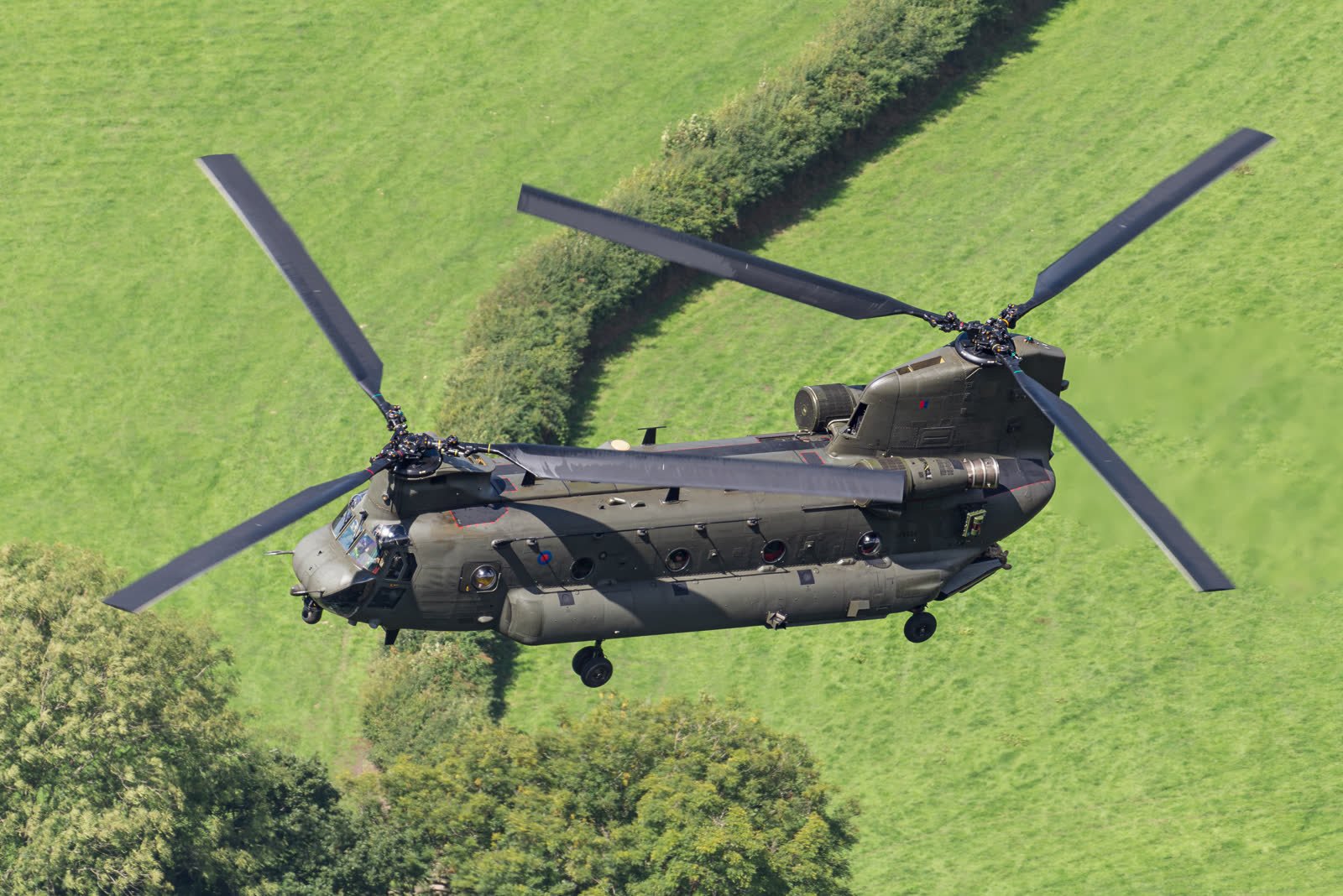
On 21 September 1961, a pre-production Boeing Vertol YHC-1B made its first hovering flight. The following year it was renamed CH-47A under the new US tri-service designation system, and by August 1962 it was in service.
Sixty-five years later that same basic shape is still in production, and it is still one of the easiest aircraft in the world to recognise from the ground. If you have ever heard a deep, rhythmic double thud coming over the rooftops and looked up to see something that resembles a flying bus, that was very likely a Chinook.
Why two rotors
Most helicopters have one main rotor and a small one on the tail. The tail rotor is there to stop the whole aircraft spinning the opposite way to its main rotor, and it costs engine power to do that job. Power spent stopping the aircraft from spinning is power not spent lifting anything.
The Chinook solves the problem differently. Its two rotors, one at each end, turn in opposite directions, so each cancels the other's twisting force. There is no tail rotor at all, which means all of the engine power goes into lift and forward flight. That is the whole reason it can carry what it carries, and it is why the design has aged so well: the physics has not changed.
It is not slow for its size, either. The type's top speed is around 170 knots, a little under 200 mph.
Sixty-five years and still in production
Over 1,200 had been built by 2012, and production has carried on since. The type is one of very few aircraft developed in the early 1960s to have stayed in both production and frontline service for more than sixty years.
The name comes from the Chinook people, who are indigenous to the Pacific Northwest of the United States.
The British Chinook
The Royal Air Force's first Chinook HC.1s arrived at RAF Odiham in Hampshire in 1981, and Odiham has been home to the RAF's heavy-lift helicopters ever since. Three squadrons fly them there today: No. 7, No. 18 and No. 27. The marks have moved on over the decades, up to the HC.6, a new build of 14 aircraft that arrived in 2013.
On the radar
Military aircraft do not always broadcast their position, and plenty never appear on a flight tracker at all. When one does, the radar on my desk shows it as a red dot instead of the usual airliner traffic.
On 21 September 2026, the anniversary itself, one went over at just 250 feet: a Boeing-Vertol CH-47, serial ZH894, callsign SHF544, sitting on the screen as a red dot. That is a completely different sight from the usual traffic at 30,000 feet. It is the same basic machine that hovered for the first time on this day in 1961.
If you see one go over this week, it is sixty-five years old in design and still doing the job it was built for. Not many aircraft can say that.
Sources
- Boeing CH-47 Chinook — Wikipedia
- RAF Odiham — Wikipedia
- Boeing CH-47 Chinook first flight — European Airshows
- Photograph: Boeing Chinook HC.6 ZK558, Corris Corner, 2018, by Julian Herzog, CC BY 4.0, via Wikimedia Commons