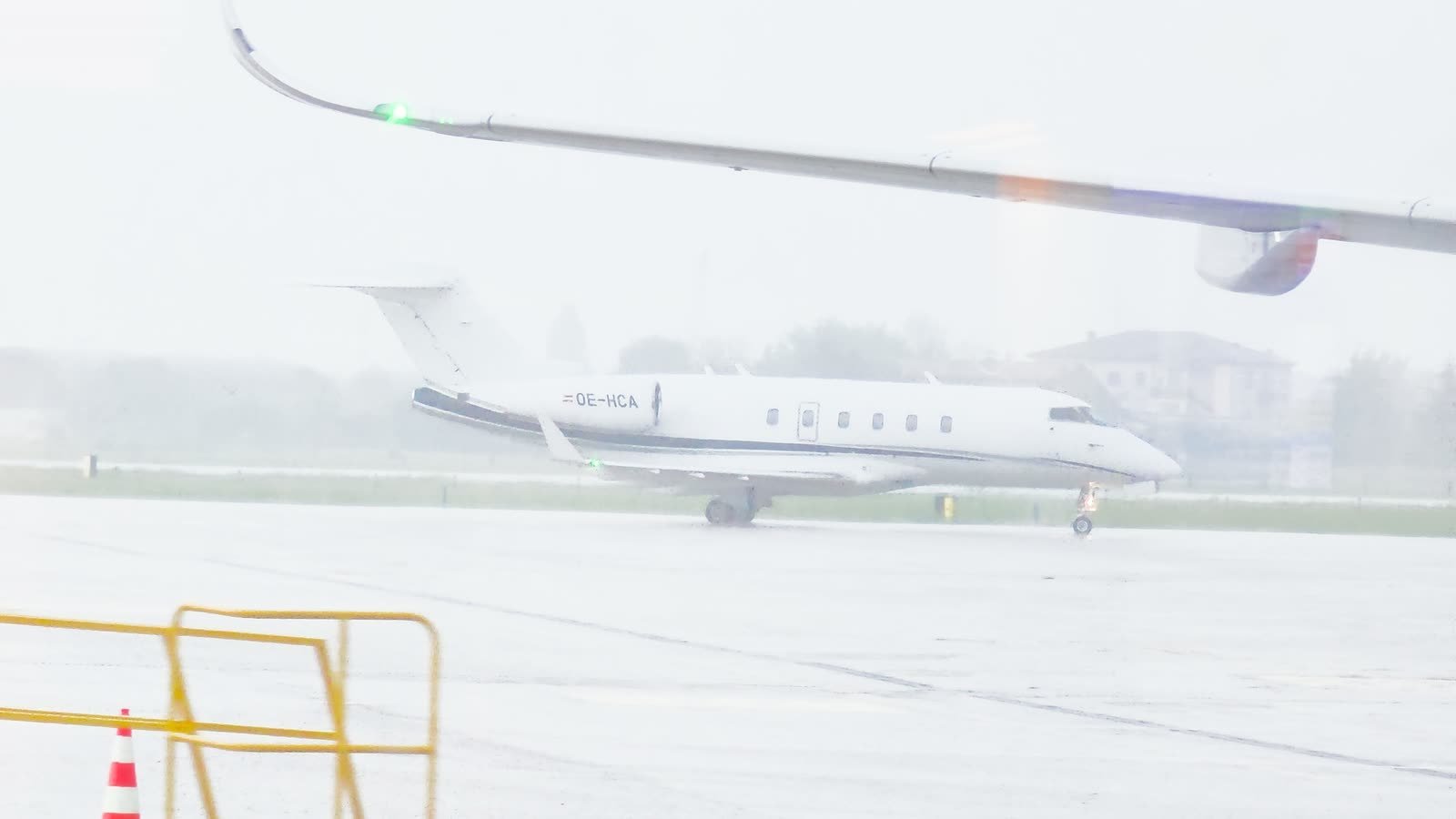
On the morning of 17 September 2026 I was standing under the terminal canopy at Verona, watching rain come down hard enough to flatten the far side of the apron into grey. Sitting out on the wet concrete was OE-HCA, an Austrian-registered business jet with the Austrian flag painted small beside the registration. A Bombardier Challenger 300.
The name is the interesting part, because it is close to meaningless.
A name that points at the wrong aeroplane
If you know business jets even slightly, "Challenger 300" sounds like it should be a junior member of the Challenger family — a smaller, cheaper stablemate to the Challenger 600 and the 604 that followed it. Sitting below the 600 in the numbering, sharing the badge, presumably sharing the wing or the fuselage cross-section or something.
It shares none of it. The Challenger 300 was not developed from the Challenger 600 or any of its variants. It is a clean-sheet aeroplane, drawn from nothing, and for most of its development it was not called a Challenger at all. Bombardier's internal and public name for the programme was the Continental. The Challenger badge was attached late, as a marketing decision rather than an engineering one.
So the aircraft on the apron at Verona carries a family name it was adopted into, not born with.
What it actually is
Stripped of the badge, the Challenger 300 is a specific and rather successful set of numbers:
- Range of about 3,100 nautical miles
- Cruise at Mach 0.80
- Service ceiling of 45,000 feet
- Eight or nine passengers in a typical layout
It first flew on 14 August 2001 and entered service on 8 January 2004, with the American fractional-ownership operator Flexjet taking the first one. Around 450 were built before the improved Challenger 350 took over the line.
Those numbers matter more than they look. Bombardier had a gap in its range between the Learjet 60 and the Challenger 604, and the 300 was drawn specifically to fill it. In doing so it more or less established the super-midsize class as a category that buyers recognised and asked for by name — a segment that barely existed as a distinct thing before it and has been fiercely contested ever since.
For an aeroplane named after a relative it is not related to, that is a decent legacy.
Why any of this shows up on a tracker
There is a practical reason a spotter ends up caring about this. Type designations on tracking sites come from the ICAO type code in Doc 8643, and the Challenger 300's is CL30 — listed there as the Bombardier BD-100 Challenger 300, covering both the 300 and the 350. The Challenger 600 series sits under a completely separate designator, CL60. If you are filtering or searching by type, treating them as one lineage will quietly give you the wrong answers.
The registration tells its own story too. The OE- prefix is Austria, allocated by Austro Control in Vienna, and OE-HCA wears a small Austrian flag ahead of the letters. An Austrian-registered aeroplane on an Italian apron in the rain is entirely ordinary in European business aviation, where the registry an aircraft sits on often has more to do with tax and operating certificates than with where it spends its nights.
The thing worth taking away
Aircraft names are marketing documents as much as engineering ones. The Challenger 300 is the clearest example I can think of: a clean-sheet design, developed under a different name, badged into a family it has no design relationship with, which then went on to define a class of its own.
Next time one taxis past, it is worth remembering that the name on the side is the least accurate thing about it.
All photographs my own.
Sources
- Bombardier Challenger 300 — Wikipedia: development history, the Continental programme name, clean-sheet origins, first flight 14 August 2001, entry into service with Flexjet 8 January 2004, production totals, and the positioning between the Learjet 60 and Challenger 604. https://en.wikipedia.org/wiki/Bombardier_Challenger_300
- OE-HCA registration, type (Bombardier BD-100-1A10 Challenger 300) and serial number 20274 — Flightradar24 and JetPhotos airframe records. https://www.flightradar24.com/data/aircraft/oe-hca and https://www.jetphotos.com/info/BCHAL-20274
- ICAO Doc 8643 type designators: CL30 (Bombardier BD-100 Challenger 300/350) and CL60 (Challenger 600 series). https://doc8643.com/aircraft/CL30
- Austrian registration marks and the OE- prefix are administered by Austro Control, Vienna. https://www.austrocontrol.at/en/aviation_agency/aircraft/aircraft_register
- Photographs and observation: Verona, 17 September 2026.