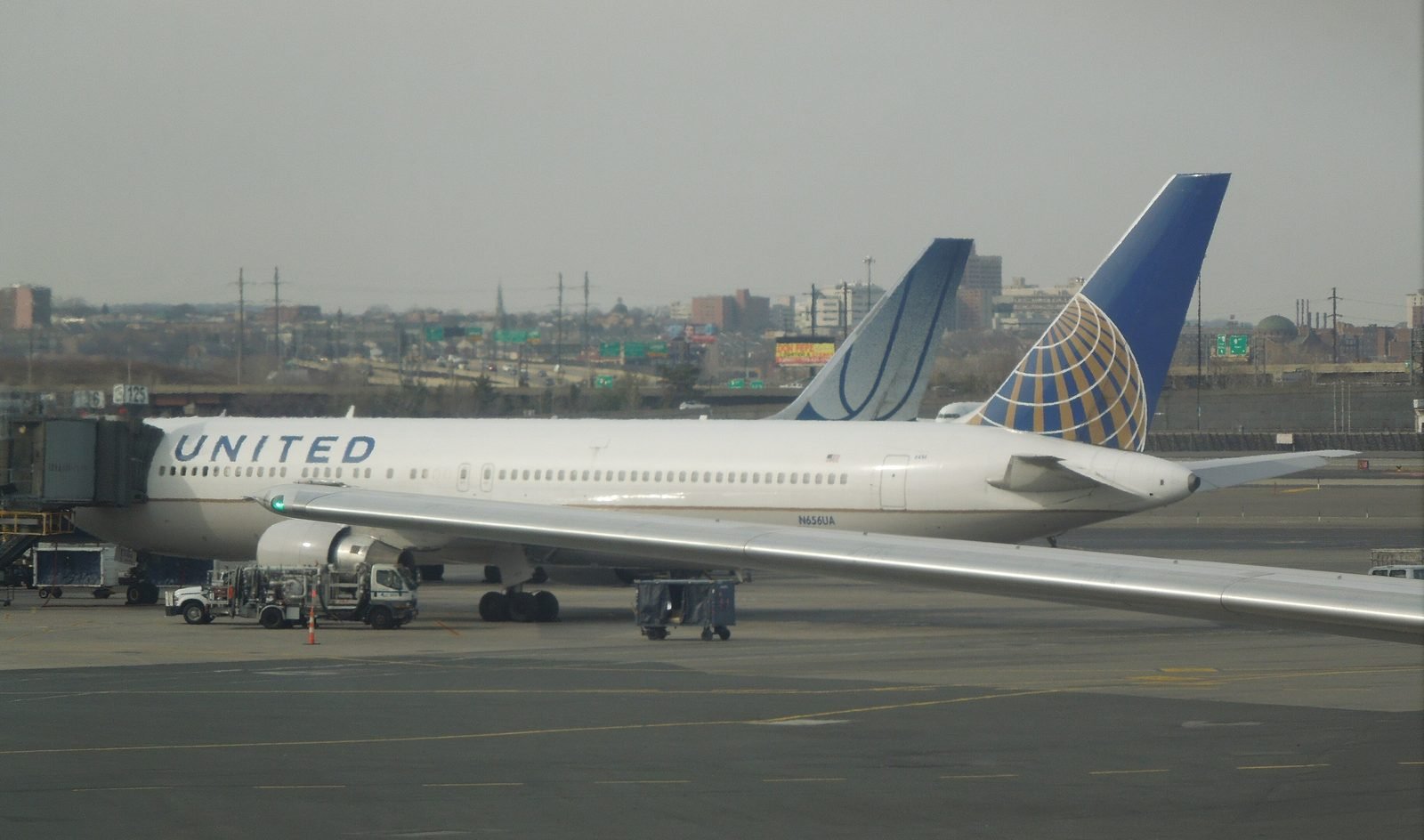
On the morning of 27 September 2026, two United Boeing 767-300s passed across the little radar on my desk within a few minutes of each other. One was N674UA, flying as UAL929 at 8,000 feet. The other was N656UA, flying as UAL52 at 37,000 feet. The FAA register says N656UA was built in 1993 and certified airworthy on 19 January that year. It is still flying the Atlantic for the airline that launched the type.
The day before, 26 September, was the 767's 45th birthday.
First flight
The prototype, registered N767BA, was rolled out at Boeing's Everett factory on 4 August 1981. It first flew on 26 September 1981, taking off from Paine Field, the airfield beside the factory. Key.aero's history of the programme records a flight of 2 hours 4 minutes with Tommy Edmonds, Lew Wallick Jr and John Brit on the flight deck.
That flight deck was one of the 767's big ideas. It was a two-crew glass cockpit, and Boeing says the 757's and 767's are nearly identical, so pilots could easily qualify to fly both. Two types, one set of pilots, was a real saving for airlines running both.
United goes first
United became the launch customer on 14 July 1978, ordering 30 aircraft. The first one, N606UA, was delivered in August 1982, and the first passenger service flew from Chicago O'Hare to Denver on 8 September 1982.
Passengers got a cabin laid out seven across, two by the windows, three in the middle, two more by the other windows. UPI reported at the launch that 88% of seats sat next to a window or an aisle. Anyone who has ever been the one in the middle of a row of three will see the appeal.
Across the ocean on two engines
The 767 was also the aircraft that opened up a new set of rules for crossing the Atlantic. On 1 February 1985, TWA flight 810 left Boston for Paris in a 767-200: the first revenue flight under new 120-minute ETOPS rules, which let a twin-engine jet fly up to two hours from the nearest diversion airport. It was not the first twin to cross (El Al had been flying 767s across under stricter rules, and A300s had crossed under 90-minute rules since the 1970s), but the two-hour rule gave twins far more of the ocean to work with.
Still flying, still being built
Boeing marked its 1,000th 767 in February 2011. Boeing's chief executive told staff in October 2024 that the company would build the remaining 767 freighters on order and then conclude commercial production in 2027. The KC-46 tanker, built on the same line, carries on. Boeing calls the 767 the only one of its products serving the passenger, freighter and tanker markets.
United's annual report says it had 37 767-300ERs and 16 767-400ERs at the end of 2025. The 767-300ERs average 29.8 years old. N656UA, at 37,000 feet on my screen, is one of the older ones.
Did you ever fly on a 767?
Sources
- Select Products in Boeing History (767 specifications) — Boeing
- Developing the Boeing 767: from drawing board to service — Key.aero
- Boeing hands over first 767 to United — Airways Magazine
- United Airlines unveiled its new wide-body Boeing 767 jetliner — UPI, 31 August 1982
- The first ETOPS flight, 1 February 1985 — Great Circle Mapper
- Boeing CEO message to employees, 11 October 2024 — Boeing
- United Airlines Holdings annual report (Form 10-K) for 2025 — SEC
- FAA aircraft registry: N656UA
- Radar catches: my own footage, 27 September 2026
- Photograph: United 767-300ER N656UA at Newark, 2014, by DReifGalaxyM31 (CC BY 3.0), via Wikimedia Commons