At about 19:47 on Sunday 27 September 2026, a British Airways Boeing 777-200 crossed the little radar on my desk at 6,475 feet, climbing out of Heathrow. The label read G-VIIG, flying as BAW183, with the route LHR→JFK underneath. Half an hour later a JetBlue A321neo, N4077J, came the other way at 8,000 feet: JBU1107, JFK→LHR.
Heathrow to New York is about as ordinary as long-haul flying gets now. Sixty-eight years ago this Sunday, it was the route on which the jet age crossed the Atlantic.
4 October 1958
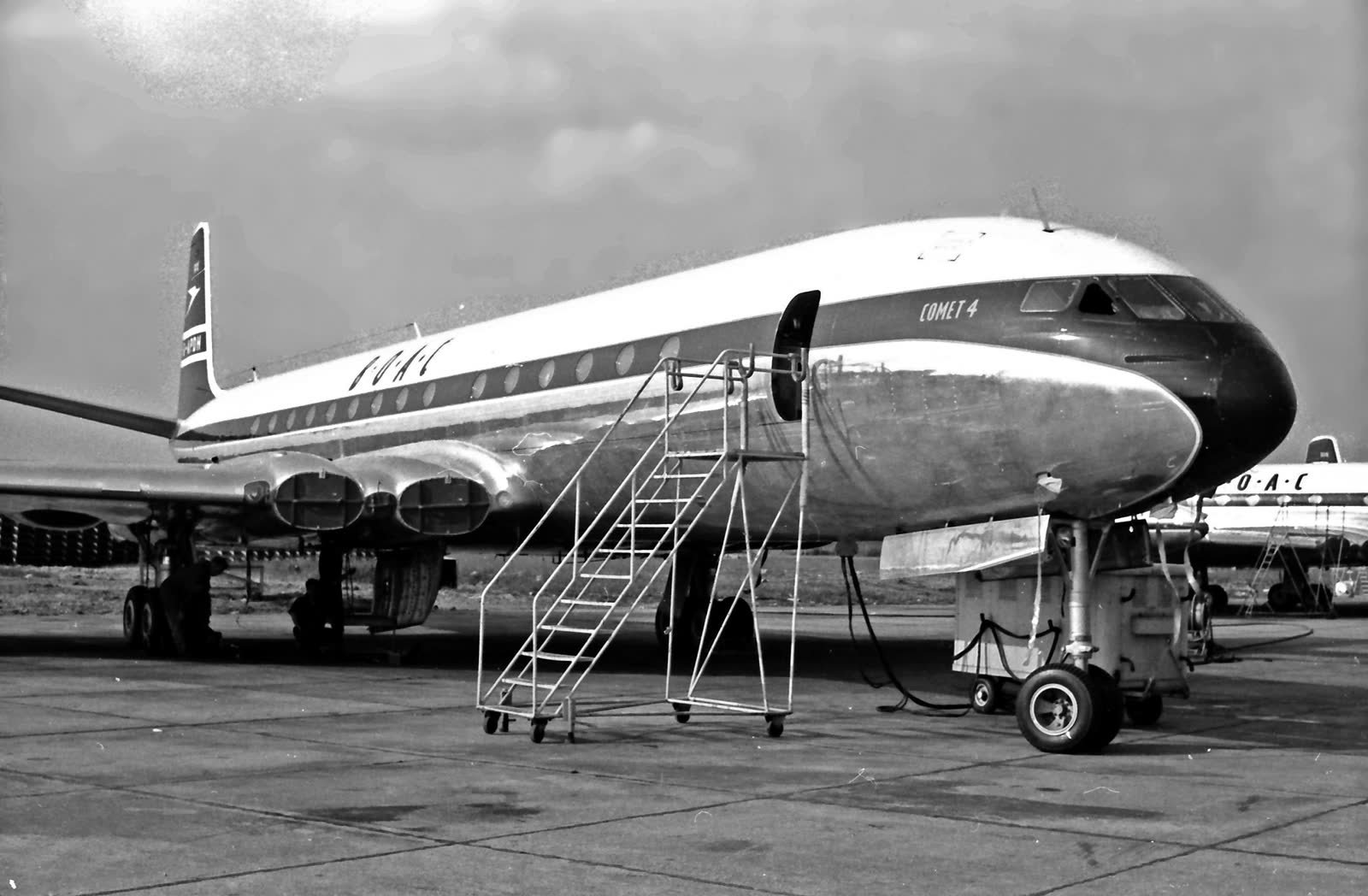
BOAC opened the first transatlantic jet passenger service on 4 October 1958, with two de Havilland Comet 4s flying in opposite directions on the same day.
Westbound, G-APDC left London Airport, as Heathrow was then called, commanded by Captain R.E. Millichap, with BOAC's chairman, Sir Gerard d'Erlanger, on board. Flying into the prevailing westerlies, it landed at Gander in Newfoundland for fuel. It reached New York Idlewild, now JFK, after a total journey of about 10 hours 20 minutes.
Eastbound, with the wind behind it, G-APDB flew New York to London non-stop, commanded by Captain Thomas Stoney. It took just over six hours: 6 hours 12 minutes according to the Duxford Aviation Society, which owns the aircraft today, and 6 hours 11 minutes in some other accounts.
Pan Am's first Boeing 707 service, Idlewild to Paris, followed on 26 October 1958. BOAC had beaten it by three weeks.
The aircraft
The Comet 4 was a larger, longer-range development of the original de Havilland Comet, powered by four Rolls-Royce Avon turbojets buried in the wing roots, each giving about 10,500 pounds of thrust. It could seat up to 81, although BOAC's first aircraft were laid out for just 48.
G-APDB today
G-APDB first flew on 27 July 1958 and was delivered to BOAC that September, a few weeks before the first service. After BOAC it flew for Malaysian Airlines from 1965, then joined Dan-Air, and made its last flight into Duxford on 12 February 1974. It was repainted in BOAC colours in 2006 and now sits on the outdoor airliner line at IWM Duxford, where you can see it today.
What the screen shows now
The route line on my screen is the simplest thing in the world: three letters, an arrow, three more letters. LHR→JFK carries no hint that the same trip once needed a refuelling stop in Newfoundland, a chairman on board and a race with Pan Am. It is worth knowing the history behind the lines.
Would you have flown on the Comet?
Sources
- 4 October 1958 — This Day in Aviation
- de Havilland Comet 4 G-APDB — Duxford Aviation Society, British Airliner Collection
- BOAC's first transatlantic jet-powered flight — Airways Magazine
- First jet to Paris, 1958 — Pan Am Historical Foundation
- de Havilland DH.106 Comet 3 and 4 — BAE Systems Heritage
- Radar catches: my own footage, 27 September 2026
- Photograph: BOAC Comet 4 G-APDH at London Airport, July 1959, by wilford peloquin (CC BY 2.0), via Wikimedia Commons