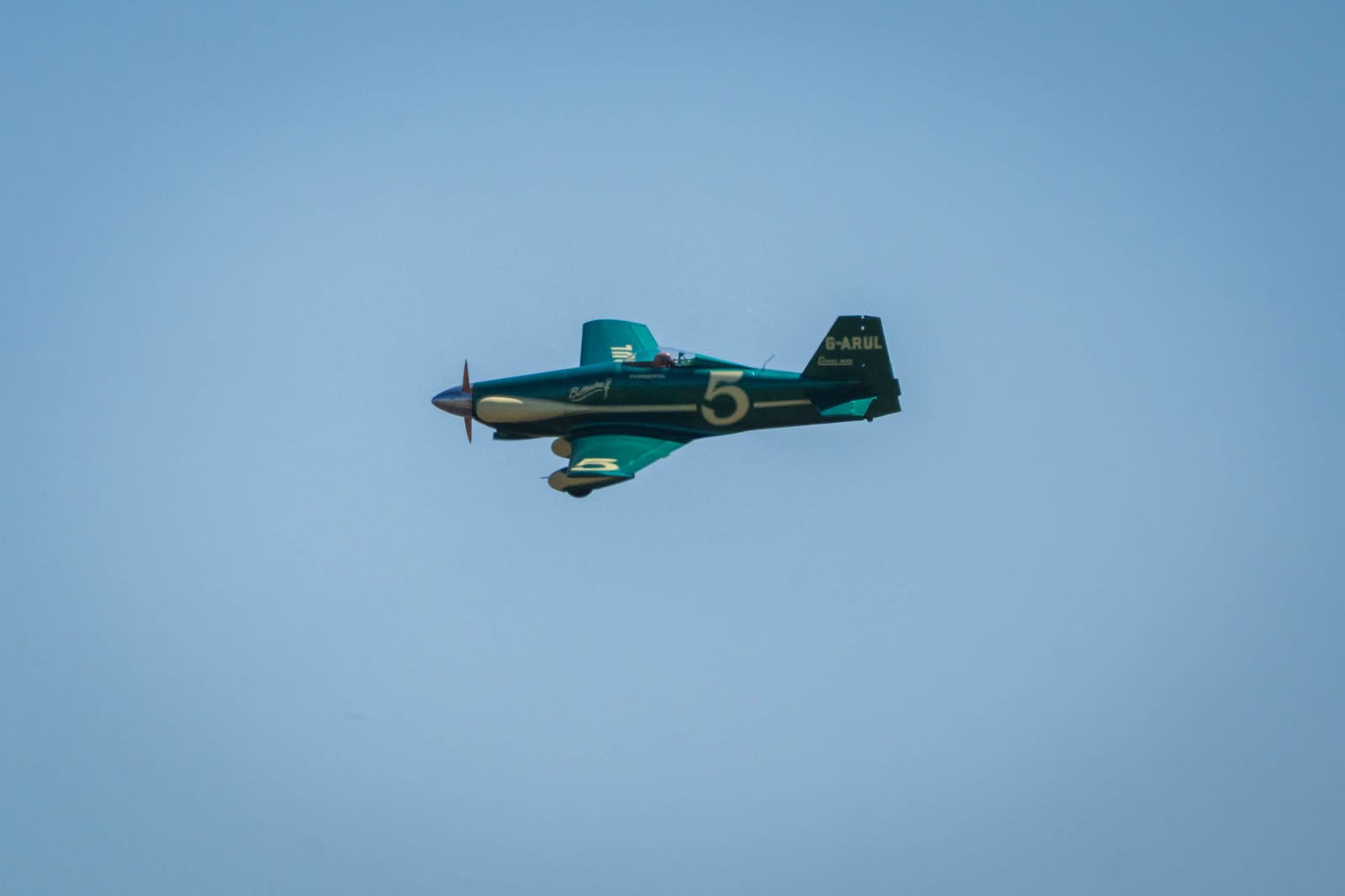
The Goodwood Revival ran from 18 to 20 September 2026, and as usual the aircraft parked along the airfield were judged as seriously as the cars. The Freddie March Spirit of Aviation concours is a beauty contest for aeroplanes, and this year's field included a 1944 de Havilland Dragon Rapide and a 1955 Cessna 170B, which finished third and second.
First place went to a 1947 LeVier Cosmic Wind, presented by Peter Kynsey. Most people know it by its registration, G-ARUL, or by the name painted on its cowling: Ballerina.
A racer built by test pilots
The Cosmic Wind was designed by Tony LeVier, Lockheed's famous test pilot, together with a small group of Lockheed colleagues who wanted to go Formula One air racing after the war. The rules were strict: a small engine, a small aeroplane, and the rest was down to drag and nerve. The first one flew on 3 July 1947.
They built three at Lockheed in 1947 and 1948: Little Toni, Minnow and Ballerina. The numbers are startling even now. The wingspan is 18 feet 11 inches, or 5.77 metres. Maximum take-off weight is 385 kilograms. The engine, a Continental C-85, made 85 horsepower, and on that the Cosmic Wind would do around 185 mph.
Across the Atlantic
Ballerina came to Britain in 1961, demonstrated to members of the Tiger Club at Redhill, and was registered G-ARUL. It started winning straight away. Neil Williams took the Shoreham air race in 1962 at 180 mph, and Dennis Hartas won the King's Cup with it in 1964.
In 1966 it was badly damaged at Halfpenny Green. It could easily have ended there. Instead it was rebuilt in Britain, this time with a 100 horsepower Continental O-200, and was back on the register in 1973. Peter Kynsey has owned it since 1984, and it has been a regular at British displays ever since. It flew at Duxford's VE Day flying day in May 2025, which is where the photograph above was taken.
Why it matters that it won
Concours judges at Goodwood tend to reward originality and presentation, and a racer is not an easy thing to keep original. Racing aircraft get modified, crashed, rebuilt and modified again. That Ballerina is still flying at all, in a livery its 1940s crew would recognise, is the achievement.
It was also a fitting year for it. The Revival marked ninety years since the Spitfire's first flight, with a trio of Spitfires flying a dawn patrol each morning. The airfield itself was RAF Westhampnett during the war. Among all that history, a 385 kilogram racer with a car-sized engine took the prize.
What it means on the screen
The radar on my desk shows what is overhead within its range, labelled by type and altitude. Most of what crosses it is airline traffic: A320s, 737s, the odd widebody. Those are easy to read.
The ones that make me look twice are the slow, low dots at a couple of thousand feet. Usually it is a training aircraft or a Cessna on a Sunday outing. But now and then the label is something built by hand, decades ago, by people who simply wanted to go fast. Not every dot is a 737.
What is the smallest aircraft you have ever seen fly?
Sources
- Freddie March Spirit of Aviation 2026 — Goodwood Road & Racing, 20 September 2026
- LeVier Cosmic Wind — Wikipedia
- A magnificent racer: Le Vier Cosmic Wind G-ARUL — Shortfinals
- Aircraft data G-ARUL — airport-data.com
- Photograph: G-ARUL at the Duxford VE Flying Day, May 2025, by p_a_h (CC BY 2.0), via Wikimedia Commons